
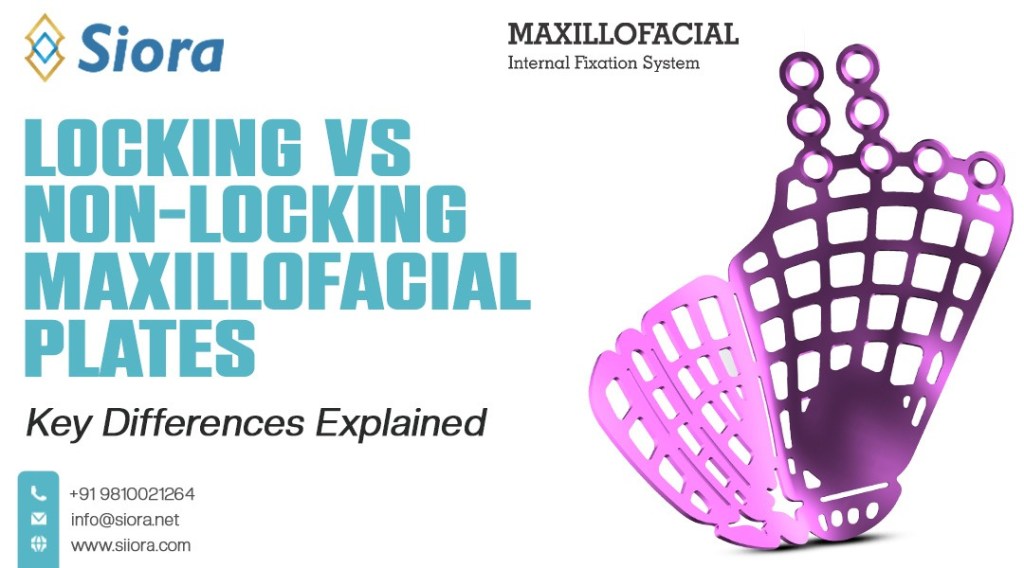
In maxillofacial surgery, fixation plays a major role in how well a patient recovers. Whether it’s a trauma case or a planned corrective procedure, the choice of maxillofacial plates can directly affect stability and healing. Surgeons often choose between locking and non-locking plates, and while both serve the same purpose, they behave quite differently once placed. Understanding these differences can make decision-making much easier in day-to-day practice.
What Are Non-Locking Plates?
Non-locking plates are the more traditional option. In this system, screws pass through the plate and compress it against the bone. Stability depends largely on how tightly the plate is pressed onto the bone surface.
This approach works well when the bone quality is good, and the fracture fragments can be aligned properly. However, because the plate must sit flush against the bone, it requires precise contouring during surgery. Even a small mismatch can affect stability or lead to uneven pressure.
What Are Locking Plates?
Locking plates are designed a bit differently. Here, the screws lock into the plate itself, creating a fixed-angle structure. The plate does not need to be tightly compressed against the bone to stay stable.
This design allows the plate and screws to function more like a single unit. It reduces dependence on bone quality and helps maintain stability even when the bone is weak or fragmented. Because of this, locking plates are often preferred in more complex cases.
Key Difference: How Stability Is Achieved?
The main difference between the two systems lies in how they hold the bone.
Non-locking plates rely on friction between the plate and bone. If that contact is lost, stability can decrease. On the other hand, locking plates depend on the screw–plate connection, which remains stable even if the plate is not perfectly pressed against the bone.
This makes locking systems more forgiving, especially in situations where perfect contouring is difficult.
Bone Quality and Clinical Use
Bone quality plays an important role in choosing between these two options. In patients with strong, healthy bone, non-locking plates can still perform well and provide reliable fixation.
However, in cases involving osteoporotic bone, comminuted fractures, or defects, locking plates offer a clear advantage. They provide better hold without relying heavily on bone strength.
Surgical Handling and Practical Considerations
From a surgical point of view, non-locking plates require careful shaping to match the bone surface. This can take time and may not always be perfect.
Locking plates are easier in this context. Since they do not need exact bone contact, minor gaps between the plate and bone are less of a concern. This can simplify the procedure, especially in difficult anatomical areas.
Healing and Blood Supply
Another point worth noting is the blood supply. Non-locking plates, when pressed tightly against the bone, can affect periosteal blood flow. Locking plates, by not requiring compression, tend to preserve this blood supply better, which may support healing.
Conclusion
Both locking and non-locking maxillofacial plates have their place in surgery. Non-locking plates remain useful in simple cases with good bone quality. However, locking plates provide added stability, ease of use, and better performance in complex situations.
In the end, the choice of orthopaedic implant depends on the fracture type, bone condition, and the surgeon’s preference. Having a clear understanding of both systems helps in selecting the right approach for each patient.
 Siora S